Personal and independent work
Jordan, a founder and advisor
Jordan works alone, but still handles investor updates, customer agreements, operating numbers, and API credentials that do not belong in an ordinary AI prompt.
A day with FusionWall
A founder preparing a board brief, an accountant explaining a variance, and an engineer reviewing an incident need different answers. FusionWall gives each of them the same understandable path: protect, review, approve, and keep the receipt.
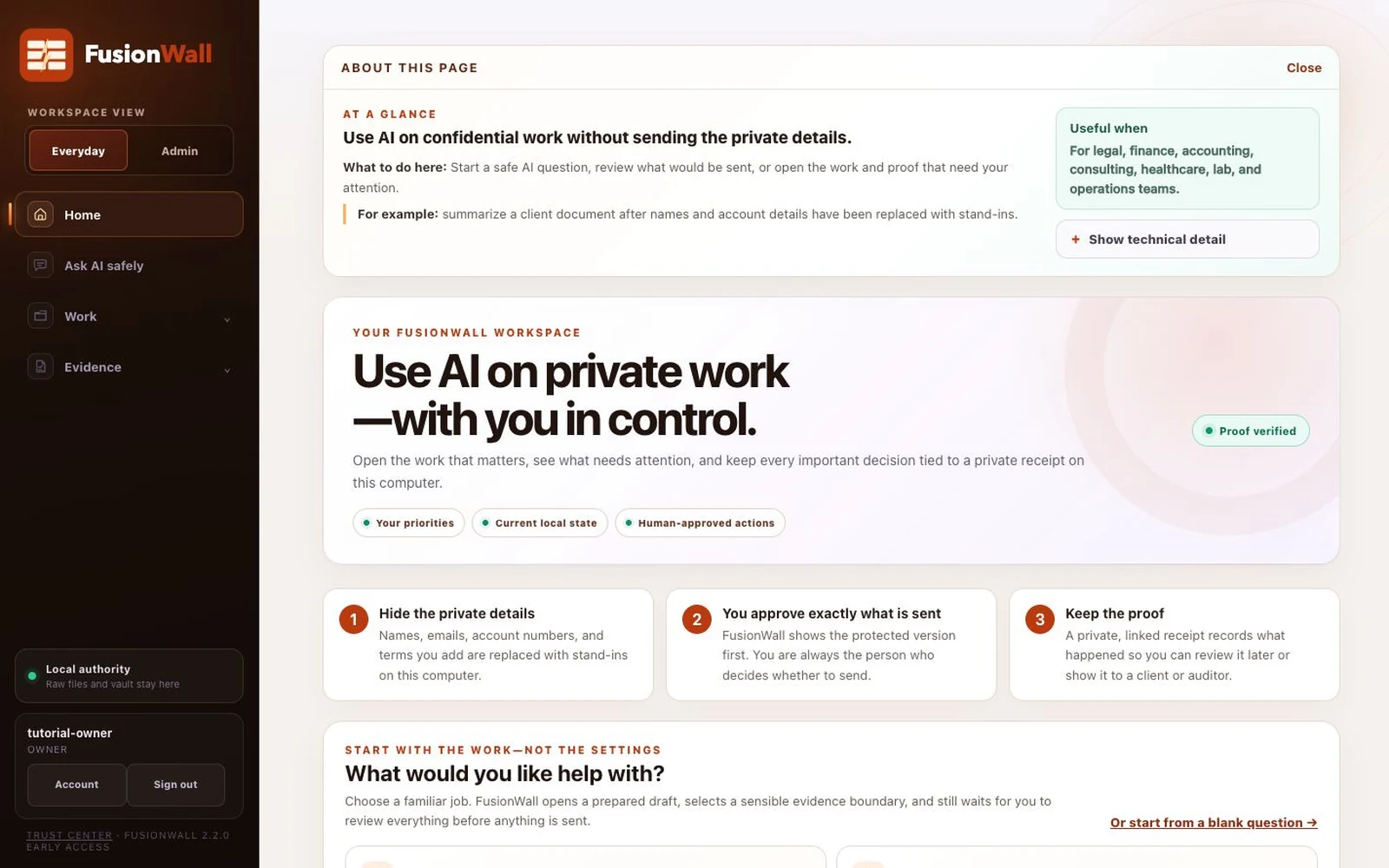
People begin with a familiar job. The controls appear when they matter.
Personal and independent work
Jordan works alone, but still handles investor updates, customer agreements, operating numbers, and API credentials that do not belong in an ordinary AI prompt.
Jordan asks for a briefing from selected notes and financial results. Names, account identifiers, and protected company terms are replaced before the request is shown for approval.
A local file is checked first. Jordan chooses the agreement sections to use and asks for obligations, renewal dates, and unclear terms.
Jordan prepares a recurring customer follow-up brief. FusionWall records the steps and keeps approval in front of the next run.
Jordan checks the proof ledger, adds a recovery point, and schedules the next contract review on the calendar.
Non-technical professional teams
They do not need to learn security terminology. They need to review agreements, explain numbers, follow policy, and show what was approved.
She opens the prepared “Review an agreement” starting point, chooses the contract, and asks for renewal obligations and dates. FusionWall shows the protected request before send.
Sam selects an approved reporting export and asks for the three largest changes, likely drivers, and questions for the department lead.
A proposed process includes an action the owner blocked. FusionWall explains which rule applies and stops the request instead of silently relaxing the policy.
They search linked receipts for the relevant work and create a reviewable report from the records they choose.
Technical teams
They need technical depth: exact endpoints, model IDs, bounded tools, automation inputs, and evidence that can survive a serious review.
Priya asks for a triage brief from selected event evidence. Hostnames, addresses, identifiers, and protected environment names are replaced before approval.
Alex reviews the proposed code artifact and its intended inputs. FusionWall does not treat model output as permission to run.
A pinned executable is checked again, exact arguments are reviewed, credentials are refused in command-line arguments, and the outcome is captured.
Priya compares the risk estimate with current evidence and selects the recovery or policy gap that would most improve the posture.
Organization-wide use · FusionWall Pro
Riley does not read everyone’s work. Riley coordinates people, devices, company policy, organization approvals, shared knowledge, and fleet evidence from infrastructure the organization controls.
Riley verifies the device identity, assigns the person and seat, and confirms the company controller fingerprint.
A proposed company policy is reviewed and approved. It can add restrictions to enrolled workstations but cannot lower the built-in safety floor.
A sensitive company-level change waits for a different authorized person to approve it.
Riley sees stale nodes, pending organization work, policy coverage, and aggregated receipt metadata, then prepares an executive evidence export.
What every day has in common
Agreement review, variance explanation, incident triage, client brief, recurring work, or a question of your own.
FusionWall exposes the protected request, applicable policy, provider route, and any warning that needs judgment.
Conversations, finished work, calendar actions, and receipts remain connected so the next day starts with context.
Choose the next view
Explore every working center, understand the three-step boundary, or compare Standard and Pro.